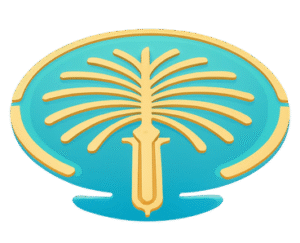
Palm Jumeirah is the world’s largest and most famous man-made island, a massive engineering feat located in Dubai, UAE. Built in the distinct shape of a palm tree, this artificial archipelago was created using only sand and rock, with no concrete or steel foundations.
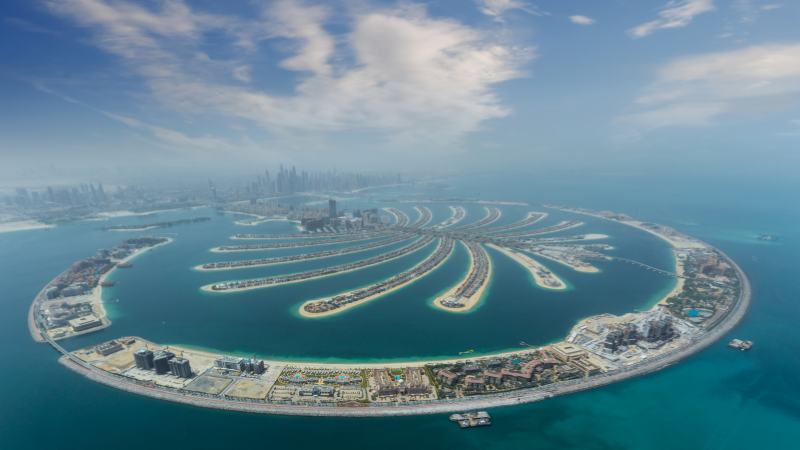
The vision behind Palm Jumeirah was to double Dubai’s natural coastline, creating a global hub for ultra-luxury living and tourism. Commissioned by Sheikh Mohammed bin Rashid Al Maktoum and developed by Nakheel, it transformed a stretch of the Persian Gulf into a high-end community featuring 17 fronds of private villas, a central trunk for commerce, and a protective 11km crescent housing world-class resorts like Atlantis, The Palm.
How Was Palm Island Dubai Built and When?
The Palm Jumeirah in Dubai was constructed through a massive land reclamation project that used 94 million cubic meters of sand and 7 million tons of rock. Notably, the main infrastructure was built entirely without concrete or steel to maintain a natural appearance.
Construction Timeline
- Start Date: Construction officially began in June 2001.
- Land Completion: The basic land reclamation and infrastructure were ready by 2004.
- Building Phase: Construction of residential units and hotels began in 2006.
- Handover & Opening: The first residents moved in during 2007, and the island’s flagship resort, Atlantis The Palm, officially opened in September 2008.
Is Dubai Palm Island Sinking?
The claim that Dubai’s Palm Jumeirah is “sinking” is a mix of observed geological settlement and sensationalized media reports. While satellite data has indicated some movement, the developer and many experts argue this is within the expected range for any major land reclamation project.
The Facts vs. The Fiction
Feature | The Fiction (Rumors) | The Facts (Scientific Reality) |
Sinking Rate | The island is “rapidly” sinking into the sea. | In 2009, satellite data from Fugro NPA suggested a subsidence rate of 5 mm per year. |
Stability | The sand is loose and will dissolve or liquefy. | Engineers used vibro-compaction to densify the sand, making the foundation as stable as natural ground. |
Sea Levels | Rising tides will submerge the Palm by 2018 or 2020. | The island stands 4 meters above high tide, and designers factored in a potential 50 cm sea-level rise. |
Current Status | Massive cracks and structural failures are appearing. | No widespread physical manifestations (cracking, pipe bursts, or broken glass) consistent with dangerous sinking have been reported by residents or the government. |
Palm Island Dubai House Prices and Villas for Sale
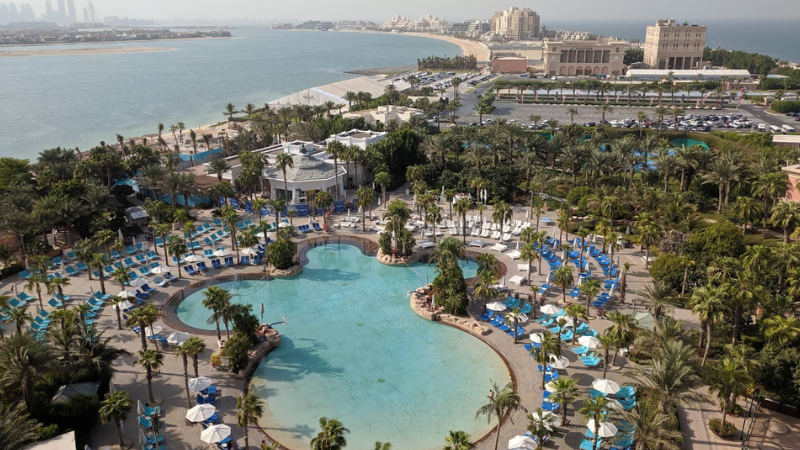
The Palm Jumeirah real estate market is one of the most exclusive in the world, with villa prices averaging approximately AED 44.6 million ($12.1 million) as of 2024, reflecting a significant 26% year-on-year increase. The island offers a variety of high-end residential options, primarily categorized by their location on the “Trunk,” “Fronds,” or “Crescent”.
Villa Price Ranges (2024-2025 Estimates)
Villas on the Palm are among Dubai’s most expensive “trophy” homes, with prices driven by private beach access and limited supply.
- 3-Bedroom Villas: Typically range from AED 10.5 million to AED 24 million.
- 4-Bedroom Villas: Prices generally start around AED 28 million, reaching up to AED 40 million.
- 5-Bedroom Villas: High-end listings often fall between AED 36.7 million and AED 75 million.
- 6+ Bedroom Mansions: These ultra-luxury estates can command between AED 49 million and over AED 115 million.
Dubai Palm Island Shahrukh Khan House and Mega Mansions
The Palm Jumeirah is a global magnet for the ultra-wealthy, home to some of the most expensive real estate ever sold. While Bollywood superstar Shah Rukh Khan owns its most famous residence, the island’s “Billionaires’ Row” features mega-mansions that have set world records for luxury and price.
Shah Rukh Khan’s Villa: “Jannat”
Shah Rukh Khan was one of the first celebrities to establish a home on the Palm. His villa, appropriately named Jannat (meaning “Heaven”), is located on the exclusive K-Frond.
- Acquisition: The villa was a formal gift from developer Nakheel in 2007 in recognition of Khan’s role as a brand ambassador for Dubai.
- Specifications: It is a 6-bedroom Mediterranean-style signature villa spanning a 14,000 sq. ft. plot with approximately 8,500 sq. ft. of built-up area.
- Design: The interiors were recently redesigned by his wife, Gauri Khan, featuring a “reflective minimalism” style that blends luxury with a cozy family atmosphere.
- Amenities: The property includes two remote-controlled garages, a private pool, and direct access to a private beach with views of the Dubai skyline.
- Estimated Value: While gifted for approximately $2.8 million in 2007, its current market valuation is estimated at roughly approx. $12 million.
The “Chairman Villa” and Mega-Mansions
While the term “Chairman Villa” often refers to the most prestigious suites in luxury hotels (like those at The Venetian or Wynn), the Palm is synonymous with “Mega Mansions” that dwarf standard luxury homes.
- Billionaires’ Row (Frond G): This is the island’s most expensive stretch. In 2022, the “Casa Del Sole” mansion on this frond sold for AED 302.5 million, featuring eight bedrooms and a private cinema.
- The Ambani Mansion: Indian billionaire Mukesh Ambani purchased a 10-bedroom beachfront villa on the Palm for approximately AED 600 million ($163 million) in 2022, which includes a private spa, gym, and 70 meters of private beach.
- Signature Mansions: Custom-built mansions on prime fronds like Frond J or Frond N can command prices exceeding AED 200 million ($54 million) in the 2025–2026 market.
Best Star Hotels and Atlantis The Palm
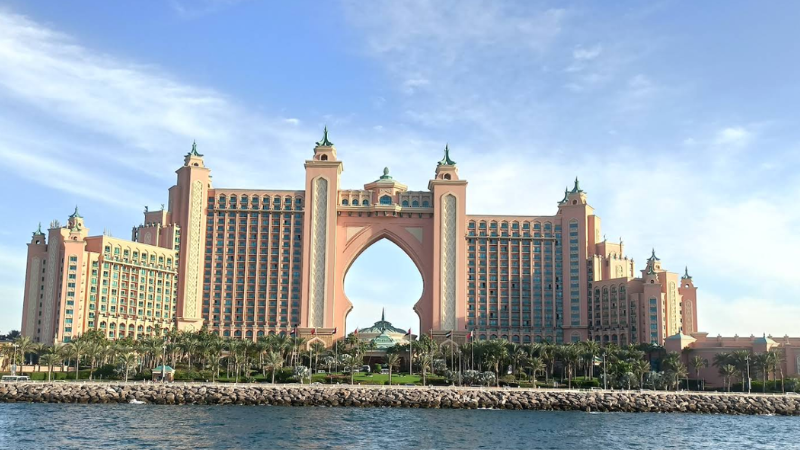
Palm Jumeirah is a global hub for luxury hospitality, dominated by iconic landmarks like Atlantis, The Palm and culturally themed resorts like Jumeirah Zabeel Saray. As of early 2026, the island hosts over 20 five-star hotels, each catering to different luxury niches from high-energy beach clubs to serene, ultra-private sanctuaries.
The Iconic Mainstay: Atlantis, The Palm
Since its opening in 2008, Atlantis, The Palm has remained one of Dubai’s most recognizable symbols, inspired by the mythology of the lost city of Atlantis.
Best For: Families, adventure seekers, and fans of massive, themed resorts.
- Key Amenities:
- Aquaventure Waterpark: The world’s largest waterpark, featuring record-breaking slides and a lazy river.
- The Lost Chambers Aquarium: An immersive underwater world home to 65,000 marine animals.
- Dining: Home to 20+ restaurants, including Nobu and Gordon Ramsay’s Bread Street Kitchen.
- Atmosphere: Lively and often busy, with a “fairytale” architecture that appeals to all ages.
Exploring Restaurants, Water Parks, and Boat Tours
Palm Jumeirah is a hub of luxury experiences, from the world’s largest waterpark to panoramic observation decks and vibrant beachfront dining.
Top Attractions and Water Parks
The island is anchored by massive entertainment complexes, primarily at Atlantis, The Palm.
1. Aquaventure World
- Rating: 4.6 (38.1K reviews) – Water Park – Palm Jumeirah
- Recognized as the world’s largest waterpark, featuring over 105 slides and attractions.
- Highlights: The “Leap of Faith” (a 27.5m near-vertical drop through a shark lagoon) and the “Odyssey of Terror” (the world’s tallest waterslide).
- Cost: Admission starts from approximately AED 315.
2.Lost World Aquarium at Aquaventure World
- Rating: 4.5 (12.8K reviews) – Aquarium – Palm Jumeirah
- An immersive maze of underwater tunnels housing 65,000 marine animals.
3.The View Palm Jumeirah
- Rating: 4.7 (22.2K reviews) – Tourist Attraction
- Located on the 52nd floor of The Palm Tower, this 360-degree observation deck offers breathtaking views from 240 meters high.
- Cost: Standard admission is roughly AED 110 (USD 30).
Pet Care for Palm Island Residents
Living in one of Dubai’s most prestigious postcodes means your pets should enjoy a lifestyle as luxurious as yours. Whether you own a signature villa on the Fronds or a high-end apartment on the Trunk, keeping your furry friends happy is easy with premium, localized care.
For residents who spend their days at the office or enjoying the island’s world-class beach clubs, professional Pet Sitting Services in Dubai provide the perfect solution for home-based care. If you are a villa owner, you know that the 11km crescent is the perfect backdrop for exercise; however, if your schedule is packed, you can rely on expert Dog Walking Services in Dubai to ensure your dog stays active and healthy in the heat.
Furthermore, for those traveling out of the city or staying at one of the Palm’s many luxury resorts that may not be pet-friendly, the island’s proximity to top-tier Pet Boarding Services in Dubai ensures your pet stays in a safe, cage-free environment. Integrating these essential services into your Dubai lifestyle is what makes the Palm a truly complete community for the whole family.
Dining and Beach Clubs
Palm Jumeirah’s dining scene is divided between high-end resort restaurants and lively beachfront promenades.
Palm West Beach
- A 1.6 km sunset-facing promenade featuring popular spots like:
- Koko Bay – Asian-inspired cuisine
- Lucky Fish – Mediterranean flavors
- Jones the Grocer – Casual gourmet dining
Fine Dining Experiences:
- Nobu Dubai: Renowned Japanese-Peruvian fusion
- Ossiano: Underwater dining at Atlantis
- Aura Skypool: The world’s highest 360-degree infinity pool with poolside dining and skyline views
The Pointe:
- Formerly a hub for the Palm Fountain. Many shops and the fountain display are now closed for redevelopment.
Boat and Yacht Tours
Exploring the Palm by water offers the best perspective of its iconic shape.
- The Yellow Boats: 60–90 minute high-speed guided tours around the Palm’s crescent
- Cost: AED 99–149 per person (shared tours)
- Private Yacht Charters: Luxury options for private groups (up to 11–18 people) starting from AED 1,399 for 60 minutes
- The Dubai Balloon: An anchored helium balloon at Atlantis rises up to 300 meters, offering aerial views without a flight
How to Get to Palm Island, Dubai, and Monorail Access
There is no direct entry fee to visit Palm Jumeirah itself, as the island’s roads, beaches, and public promenades like Palm West Beach are free to access. However, most visitors enter via the Palm Monorail, which requires a separate ticket.
The Palm Monorail
The monorail is a driverless, elevated system that runs the length of the island’s “trunk” to the crescent.
- Operating Hours: Daily from 9:00 AM to 10:00 PM. Trains depart every 15 minutes.
- Ticket Prices:
- One-way: Starts at AED 10.
- Round-trip: Starts at AED 15 (to Atlantis is typically AED 30).
- Unlimited Day Pass: AED 35 (best for hopping between stations).
- Important: You cannot use a standard RTA Nol Card for payment; tickets must be bought at stations or online.
- Key Stations:
- Palm Gateway: The main entrance station on the mainland.
- Al Ittihad Park: Direct access to the central park and Golden Mile.
- Nakheel Mall: Connected to the mall and The View at The Palm.
- Atlantis Aquaventure: The final stop for the resort and waterpark.
How to Get There
Since the Dubai Metro does not go directly onto the island, you must transfer at the base.
- By Metro & Tram (Recommended): Take the Metro Red Line to Sobha Realty or Al Khail stations, then transfer to the Dubai Tram. Ride the tram to the Palm Jumeirah Tram Station, which is connected to the Palm Gateway Monorail Station via a footbridge.
- By Bus: There is no direct public bus onto the island. You can take Bus 8 to the “Palm Jumeirah Monorail Station” stop on the mainland and then walk to the Gateway station.
- By Car/Taxi: Taxis can drive you directly to any point on the island. If driving yourself, Palm Gateway Station offers 3 hours of free parking if you validate your monorail ticket.