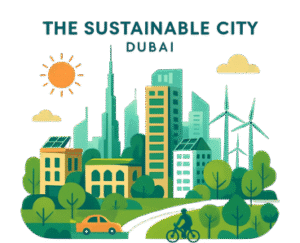
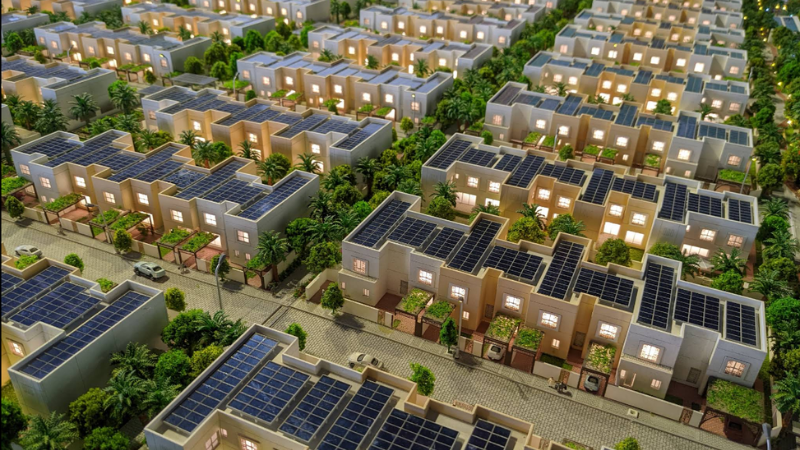
The Sustainable City in Dubai is a 46-hectare “living laboratory” and the first fully operational net-zero energy community in the Middle East. Designed to balance environmental impact with high quality of life, it houses roughly 3,000 residents in 500 solar-powered villas. The development is famous for its car-free residential clusters, where transport is limited to walking, cycling, or electric buggies, and its central green spine featuring 11 bio-domes for urban farming.
The city operates on a unique economic model where revenue from its commercial plaza and solar energy production offsets maintenance costs, allowing residents to enjoy zero service fees. Beyond its technical green features like 100% water recycling and 90% waste diversion, it is recognized as a social hub, featuring the Fairgreen International School and Sanad Village, a world-class center for autism, making it a global benchmark for holistic urban sustainability.
The Sustainable City -The Middle East’s First Net-Zero Community
The Sustainable City (TSC) in Dubai is the Middle East’s first fully operational net-zero energy community. Spanning 46 hectares (113 acres) in the Dubailand district, it was developed by Diamond Developers as a global benchmark for sustainable urban living.
The Visionary Concept Behind Diamond Developers
The project was born from a desire to move beyond traditional real estate by offering a sustainable lifestyle rather than just a product.
- Three Pillars of Sustainability: The development follows a “triple bottom line” approach, ensuring environmental, social, and economic viability.
- Proof of Concept: Originally launched in 2013, the city serves as a “living lab” to demonstrate that net-zero living can be achieved without compromising luxury or comfort.
- Financial Innovation: To ensure economic sustainability, residents pay zero service or maintenance fees. This is achieved by sharing the rental income from the community’s mixed-use plaza with the homeowners.
- Behavioral Change: The developer emphasizes that infrastructure is only half the job, the other half is educating residents to practice sustainable habits, such as recycling and water conservation.
Strategic Location and Connectivity Within Dubailand
Located along Al Qudra Road (D63), the city is positioned in the heart of Dubailand, a major residential and leisure hub in Dubai.
- Major Connectivity:
- Downtown Dubai: ~20 minutes drive.
- Al Maktoum International Airport: ~20-25 minutes drive.
- Dubai International Airport (DXB): ~30-35 minutes drive.
- Neighboring Communities: It is situated adjacent to Arabian Ranches and close to Mudon, Layan, and DAMAC Hills.
- Local Transport: While designed to be car-free internally using electric buggies and shuttle buses, it is connected to the city via RTA bus routes (J02 and F32) at the main entrance.
- Nearby Attractions: Residents have quick access to Global Village (12 mins), Dubai Miracle Garden (10-15 mins), and the Al Qudra Cycling Track
Engineering a Greener Future
The city’s engineering focuses on reducing resource consumption while enhancing the quality of life. It employs a car-free design where residential clusters are pedestrian-only, with parking located at the perimeter. This layout encourages walking and cycling along extensive dedicated paths, making it a premier location for dog walking in Dubai. The safe, shaded “sikkas” (alleys) allow residents and their pets to explore the community without the noise or danger of traffic.
Solar Energy
- Solar Integration: The city features over 40,000 solar panels installed on villa rooftops and shaded parking areas.
- Energy Capacity: The solar array generates approximately 10 megawatts (MW) of peak power annually.
- Net-Zero Goal: This clean energy powers homes, street lighting, electric vehicle (EV) charging stations, and water treatment systems.
- Cost Efficiency: High-efficiency solar inverters and energy-saving appliances help residents save 30%–40% on utility bills, contributing to a “net-zero” service charge model.
Passive Design
- Building Orientation: Villas are oriented toward the north to minimize direct exposure to the harsh desert sun, naturally reducing heat gain.
- High Insulation: The use of specialized building materials and high-performance insulation helps maintain stable indoor temperatures.
- Traditional Techniques: Modernized wind towers (Barjeels) and narrow shaded streets (sikkas) utilize the “stack effect” to pull in cool air and exhaust warm air naturally.
- Glazing & Shading: Triple-glazed windows and strategically placed shading devices block up to 90% of solar radiation.
Water Conservation
- 100% Recycling: All wastewater generated in the city is treated on-site.
- Greywater Use: Water from showers and sinks is collected and treated locally to irrigate the city’s “Green Spine” and urban farms.
- Smart Irrigation: The community uses advanced irrigation systems and low-flow water fixtures, resulting in 40% lower consumption than the Dubai average.
- Urban Landscape: Recycled water flows through a series of lakes and streams that also support the city’s biodomes.
Achieving Zero Waste
- Landfill Diversion: The city has achieved an 85% to 89% diversion rate of waste from landfills.
- Waste Sorting: Residents sort waste at the source into recyclables and compostables.
- On-Site Composting: Organic waste is converted into nutrient-rich compost to support the city’s 11 biodome greenhouses and community gardens.
- Recycled Materials: Construction waste from early development phases was repurposed to create community street furniture.
The Central Green Spine
The Central Green Spine is a “spinal park” that runs the entire length of the community, serving as its productive heart.
- Purpose: It transforms the landscape into a functional urban farm, reducing dependency on imported food and supporting local food security.
- Irrigation: The spine is irrigated using recycled greywater collected from villas and treated in an on-site underground facility.
- Water Management: Treated water flows through a series of lakes and streams via traditional irrigation channels known as falaj.
The 11 Iconic Biodomes
Stretched along the Green Spine are 11 bio-dome greenhouses that facilitate high-yield organic farming in an arid climate.
- Capacity: These domes cover over 3,000 square metres.
- Production: They are designed to grow a diverse range of fruits, vegetables, and herbs year-round.
- Innovation: Some facilities within the city can produce up to 4 tons of strawberries annually in a single container-sized vertical farming unit.
Community Allotments
Beyond the professional farm, the city provides space for residents to engage directly with the soil.
- Individual Plots: Residents are provided with urban farm allotments adjacent to their properties.
- Support: The community offers access to compost, potable water, and a social club that guides residents through the growing process.
- Education: A bespoke course, developed with the University of California, Davis, teaches residents the basics of urban farming.
Animal Sanctuary and Specialized Pet Care
A Pedestrian-First Lifestyle
This eco-friendly community, developed by Diamond Developers, is widely recognized for its “Pedestrian-First” design and has been consistently named the happiest community in Dubai (and the GCC) by the Dubai Land Department.
Car-Free Residential Clusters and Electric Mobility
The community is designed to prioritize people over cars through several innovative mobility features:
- Car-Free Zones: Residential clusters are entirely car-free to encourage walkability and safe play for children.
- Buffer Zone: A 10-meter-high “green buffer” of 2,500 trees surrounds the development to purify air and cool the community.
- EV Infrastructure: The city features approximately 250 electric vehicle (EV) charging stations and parking rooftops covered with solar panels.
- Alternative Transport: Residents use shared electric buggies, electric buses, and horse-drawn carriages for internal movement.
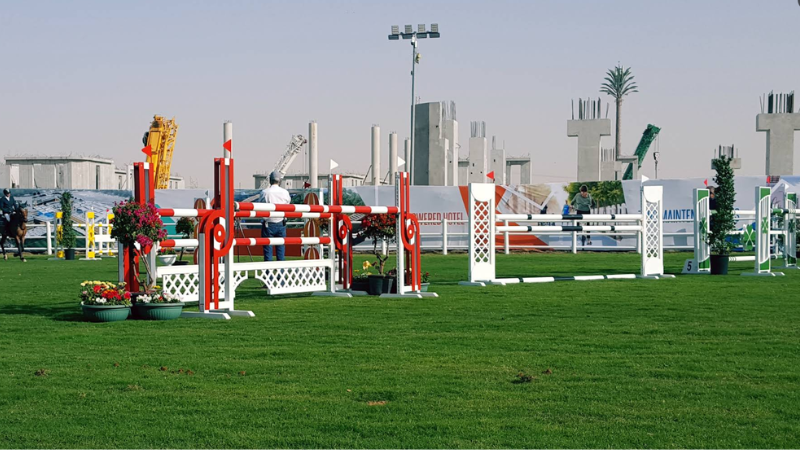
The Equestrian Centre
The Sustainable City Equestrian Club is a central hub for residents and visitors:
- Instruction: Offers English-style riding lessons for all ages (3+) and skill levels, led by British Horse Society-qualified instructors.
- Amenities: Features four large outdoor sand and grass riding schools and manages roughly 45 school horses.
- Track: A 4-kilometer hacking track encircles the entire community, providing a scenic route for riders.
Why It Is Ranked Dubai’s Happiest Community
Its consistent ranking as the happiest community is attributed to a high “well-being” factor and social cohesion:
- Economic Savings: Residents benefit from zero service charges and significantly lower utility bills due to solar energy and high-efficiency building designs.
- Urban Farming: Includes 11 biodomes and community gardens where residents can participate in gardening and access organic food.
- Community Spirit: Frequent social activities, animal sanctuaries (including donkeys, goats, and ducks), and shared green spaces foster a close-knit environment among like-minded neighbors.
Education and Essential Amenities Within the City
Fairgreen International School is the first sustainability-focused school in Dubai, offering the full International Baccalaureate (IB) curriculum from Pre-KG to Grade 12.
- Sustainability Features: The campus is powered by solar energy, recycles water for agricultural use, and features wind towers for natural cooling.
- Hands-on Learning: Students have direct access to the city’s biodomes, urban farming plots, and a “Junior Innovation Centre” to study ecology and environmental science.
- Innovative Facilities: Includes technology-enabled classrooms, “maker spaces” with 3D printers, and mobile food technology labs.
The Sustainable Plaza
The Sustainable Plaza serves as the community’s commercial heart, spanning 15,000 square meters.
- Retail & Dining: Features a mix of eco-conscious tenants, including a Zoom supermarket, organic cafes like Spill the Bean, and restaurants such as Sanderson’s and Maria Bonita.
- Workspace: Offers five low-rise blocks with office spaces for lease, attracting organizations like the Emirates Nature-WWF.
- Living: The upper floors contain leasehold apartments ranging from studios to two-bedroom units.
Integrated Wellness
The city prioritizes health through specialized medical centers and unique fitness infrastructure:
- Healthcare: Home to Sanad Village, the region’s largest rehabilitation hospital for People of Determination, and the Kairon Polyclinic for general medical needs.
- Power-Generating Gym: The community gym uses energy-producing fitness equipment where residents’ workouts help generate power for the facility.
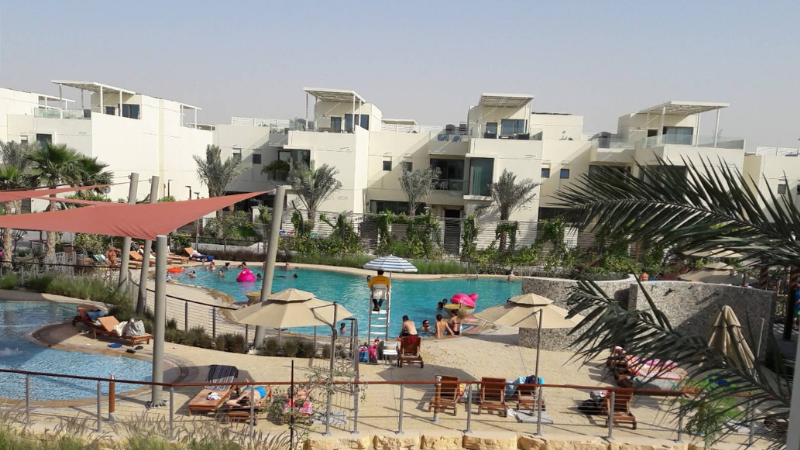
- Outdoor Activity: Residents have access to a 4 km jogging track, a 4 km cycling track, and communal swimming pools.
The Economics of Sustainable Living
The Sustainable City (TSC) in Dubai, developed by Diamond Developers, represents a pioneering, 46-hectare, net-zero energy community that aligns eco-conscious living with financial profitability. As a premier, operational, net-zero energy community, it offers investors a unique, low-cost operating model with strong, long-term capital appreciation potential.
Residential Options
The community offers diverse housing units designed with high-performance thermal insulation and energy-efficient appliances.
- Villas & Townhouses: There are 498 villas divided into five clusters (Lulu, Berhi, Hilali, Jabri, and Khalas).
- Courtyard Villas: 3 and 4-bedroom options (approx. 3,362 to 3,850 sq. ft.).
- Garden Villas: Larger 4-bedroom units (approx. 5,140 sq. ft.).
- Signature Villas: Premium 5-bedroom residences (approx. 8,000 sq. ft.).
- Apartments: Located in The Sustainable Plaza, these include 89 leasehold units ranging from studios to one- and two-bedroom apartments.
The Financial Edge
This project is famous for its Zero Service Charge model for villa owners, made possible by a circular economic strategy:
- Commercial Revenue Sharing: Owners are essentially “partners” in the community’s 15,000 sq. m. retail and office space. Revenue from these commercial leases is used to offset community maintenance costs.
- Energy Savings: Solar panels covering parking lots and rooftops generate roughly 3MW of peak energy, powering streetlights, water treatment, and urban farms at no cost to residents.
- Reduced Utility Bills: High-efficiency cooling and insulation lead to 40 – 50% lower DEWA (utility) bills compared to conventional Dubai villas.
Market Trends
For property investors, the community is a “green jewel” with strong performance metrics as of early 2025:
- Strong Returns: Average ROI is estimated between 6.2% and 8%, with three-bedroom villas typically showing the highest yields.
- High Occupancy: The community maintains a near-full 97–99% occupancy rate, driven by the influx of long-term, eco-conscious tenants.
- Capital Appreciation: Property values saw a significant boost following global events like COP28, with some reports noting 12.5% year-on-year appreciation.
- Future Outlook: Analysts project that sustainable developments in Dubai could outperform traditional areas by 18% in total ROI over the next five years