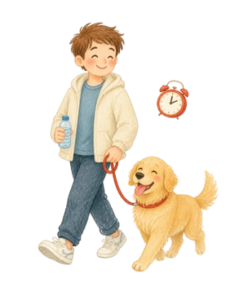


Most healthy adult dogs do best with two walks a day, one in the morning and one in the evening, adding up to somewhere between 30 minutes and two hours of activity. Puppies need short and frequent outings, high energy breeds need more, and senior dogs need gentler walks spread across the day. A quick trip outside to pee does not count as a walk.
The right number depends on your own dog, so this guide shows you how to set it by age, breed and energy, how long each walk should last, and how to tell when your routine is working.
How many times a day should you walk your dog?
For most adult dogs, two proper walks a day is the right starting point. Very active dogs often need a third outing or a longer play session on top.
Two walks give your dog a reason to wake up and move, and a calm way to settle before night. They also break up long hours indoors. Between those walks, most dogs still need short toilet breaks, so your dog should never wait a full working day without a chance to relieve itself.
Some owners manage one long walk a day and their dog seems fine. That can work for a calm, older dog, but most dogs are happier when their activity is split. One long walk followed by twelve quiet hours often leads to restless evenings and early morning wake up calls.
How long should each walk be?
Each walk should last long enough to leave your dog relaxed, not exhausted. For most adult dogs that means 20 to 60 minutes per walk, depending on energy level.
Use this table as a starting point, then adjust it to what you see in your dog.
| Your dog | Walks per day | Length of each walk | What to keep in mind |
|---|---|---|---|
| Puppy (fully vaccinated) | 2 to 4 short outings | About 5 minutes per month of age, twice a day | Let them sniff and rest often |
| High energy adult (Border Collie, Husky, Labrador, working breeds) | 2 to 3 | 45 to 60 minutes | Add fetch, running or scent games |
| Moderate energy adult (Beagle, Cocker Spaniel, most mixed breeds) | 2 | 30 to 45 minutes | One brisk walk, one relaxed walk works well |
| Low energy or small adult (Shih Tzu, Pug, French Bulldog) | 2 | 15 to 30 minutes at an easy pace | Flat faced breeds overheat quickly |
| Senior dog | 2 to 3 short walks | 15 to 30 minutes | Comfort matters more than distance |
These are guidelines, not rules. If your dog has a health condition, your vet is the best person to set the limit.
Why a toilet break is not the same as a walk
A real walk gives your dog exercise for the body and work for the nose. A two minute trip to the patch of grass outside your building gives neither.
Sniffing is one of the most tiring things a dog can do. When your dog stops to read every lamp post, it is processing information, and that mental effort calms many dogs as much as running does. That is why a slow, sniffy 30 minute walk can leave a dog more settled than a fast 30 minute march.
A good daily routine includes both types:
- An exercise walk at a steady pace, so your dog’s heart and muscles work.
- A sniff walk where your dog sets the pace and chooses where to explore.
If you want to know what all this activity does for your dog’s body and mood, our guide to the health benefits of walking your dog every day covers it in detail.
How your dog’s age changes the walking routine
Age changes how much walking a dog can handle more than any other factor. The same dog needs a very different routine at four months, four years and twelve years.
Puppies
Puppies need short, frequent walks because their bones and joints are still growing. A common guide is five minutes of exercise per month of age, twice a day, so a four month old puppy would have two walks of about 20 minutes (Royal Canin).
Wait until your vet confirms your puppy is fully vaccinated before walking in public areas. Avoid long runs, stairs and jumping games until your puppy is fully grown, which takes longer for large breeds. Training sessions count as exercise too, so a puppy that has had a busy training morning needs a shorter walk.
Adult dogs
Adult dogs can handle the full routine for their energy level. This is the stage where most behaviour problems linked to boredom appear, such as chewing, barking or pulling hard on the lead, and the fix is often a better walking routine rather than more training.
Senior dogs
Older dogs still need daily walks to keep their joints moving and their weight steady. What changes is the shape of the walk: shorter, slower and more often. Three gentle 15 minute walks usually suit a senior dog better than one long one. Watch for stiffness the next morning, lagging behind or sitting down mid walk, and shorten the route if you see them.
How heat and weather change your dog’s walks
Hot weather is the biggest safety risk on a dog walk. Pavement holds heat long after the air feels comfortable, and it can burn paw pads quickly.
Before you head out on a warm day, try the seven second test: press the back of your hand on the pavement. If you cannot keep it there for seven seconds, it is too hot for your dog’s paws. On hot days:
- Walk early in the morning or after sunset.
- Choose grass or shaded paths over asphalt.
- Carry water and stop for short breaks.
- Keep flat faced breeds such as Pugs and Bulldogs to short, slow walks.
Heavy panting, thick drool, wobbly legs or a dog that lies down and will not move are signs of overheating. Move your dog into the shade, offer water and call your vet.
When it is too hot or wet to walk for long, use indoor games to fill the gap. These tips to tire your dog indoors work well on days when the walk has to be short.
Signs your dog needs more walking, or less
Your dog’s behaviour at home tells you whether the routine is right. A dog that gets the right amount of walking is calm indoors, sleeps well and is keen but not frantic when the lead comes out.
Signs your dog needs more walking:
- Chewing furniture, shoes or doors
- Barking or whining for attention in the evening
- Restlessness at night
- Gaining weight on the same food
- Pulling hard as soon as the walk starts
Signs your dog is walking too much:
- Limping or stiffness after rest
- Lagging behind or refusing to continue
- Red, sore or worn paw pads
- Sleeping much more than usual the next day
Change the routine slowly. Add or remove about five to ten minutes a day and watch your dog for a week before changing again.
A simple weekly walking plan for busy owners
The hardest part of walking a dog is not knowing how often to do it, it is keeping it going on busy days. A fixed plan helps, because dogs settle best when walks happen at roughly the same times.
Here is an example for a healthy adult dog whose owner works office hours:
| Time | Weekdays | Weekends |
|---|---|---|
| Morning | 30 minute brisk walk before work | Longer walk somewhere new, 45 to 60 minutes |
| Midday | 15 to 20 minute toilet break and sniff walk | Relaxed sniff walk |
| Evening | 30 to 40 minute walk with some play | Evening walk and a short training game |
The midday slot is the one most owners miss. If you cannot get home, a professional dog walker can keep that walk on time. Pawland’s dog walkers meet you and your dog before the first walk, share their live location during every walk and tell you about any changes they notice in your dog’s potty habits.
On days when your dog seems tired or sore, keep the walks but make them shorter and slower. Most dogs do not need a full day without walking. They need an easier day.
Finding the right walking rhythm for your dog
Start with two walks a day, size each one to your dog’s age, breed and energy, and let your dog’s behaviour guide the changes. Mix brisk walks with sniff walks, protect paws on hot days and keep the times steady.
If your days run long and the midday walk keeps slipping, you can book a Pawland dog walker so your dog’s routine stays the same every day.